Manufacturing plants are busy places. Machines run nonstop, materials are constantly in transit, and everything in the plant is productive to getting the most out of the processes. But one key element is often overlooked until it causes expensive issues: the air within the facility.
With OSHA regulations tightening, environmental standards increasing, and expectations for workplace safety rising, maintaining clean indoor air has become an important part of modern manufacturing.
Whether you are making automotive parts, food products, pharmaceuticals, electronics, wood products, or fabricated metals, you cannot forget about airborne contaminants. Dust, welding fumes, chemical vapors, oil mist, smoke, and fine particles can impact employee health, equipment performance, product quality, and regulatory compliance.
Selecting the right manufacturing air filtration systems can help establish a safer, cleaner, and more efficient workplace while safeguarding your operations in the long run.
Regulations Continue Raising the Bar
Manufacturers today operate under increasing regulatory scrutiny.
Organizations including:
continue to tighten workplace exposure limits, ventilation requirements, and emissions standards.
Facilities that deal with combustible dust must also follow NFPA standards such as NFPA 652, NFPA 654, and NFPA 484 depending on what they are working with.
Failing to meet these standards can result in:
- Costly penalties
- Production shutdowns
- Increased insurance costs
- Employee compensation claims
- Legal liability
- Reputational damage
HVAC filtration systems in modern industry help manufacturers stay compliant while creating a safer working environment for everyone in the facility.
Choosing the Right Air Filtration System for Manufacturing Plants
Not all manufacturing facilities produce the same airborne contaminants. Several factors affect system selection:
Type of Contaminant
Different filtration technologies are optimized for different pollutants.
For example:
- Fine dust requires high-efficiency particulate filtration.
- Chemical vapors require activated carbon media.
- Oil mist demands specialized mist collectors.
- Welding operations require dedicated fume extraction.
- Pharmaceutical manufacturing often requires HEPA filtration.
Airflow Requirements
Large production facilities may require hundreds of thousands of cubic feet of air movement per minute, while smaller operations may only need localized source capture.
Proper sizing of the airflow is important. Oversized systems waste energy and undersized systems do not effectively capture airborne contaminants.
Facility Layout
Open manufacturing spaces behave very differently from compartmentalized production lines.
Engineers evaluate:
- Ceiling height
- Equipment placement
- Employee workstations
- Production flow
- Existing HVAC infrastructure
- Exhaust locations
These factors are the key to the most favorable location of the filtration units.
Future Expansion
Installing scalable industrial air filter solutions today can prevent expensive retrofits later.
Modular filtration systems give facilities the ability to expand capacity without having to replace the entire ventilation network.
Planning for future growth can often save a lot more than multiple system upgrades.
Understanding Manufacturing Air Filtration: The Core Technologies
Industrial air filtration systems are available in several types, tailored to specific contaminants and manufacturing processes. It’s good to know these distinctions so you can choose the right solution.
Mechanical Filtration: The Foundation
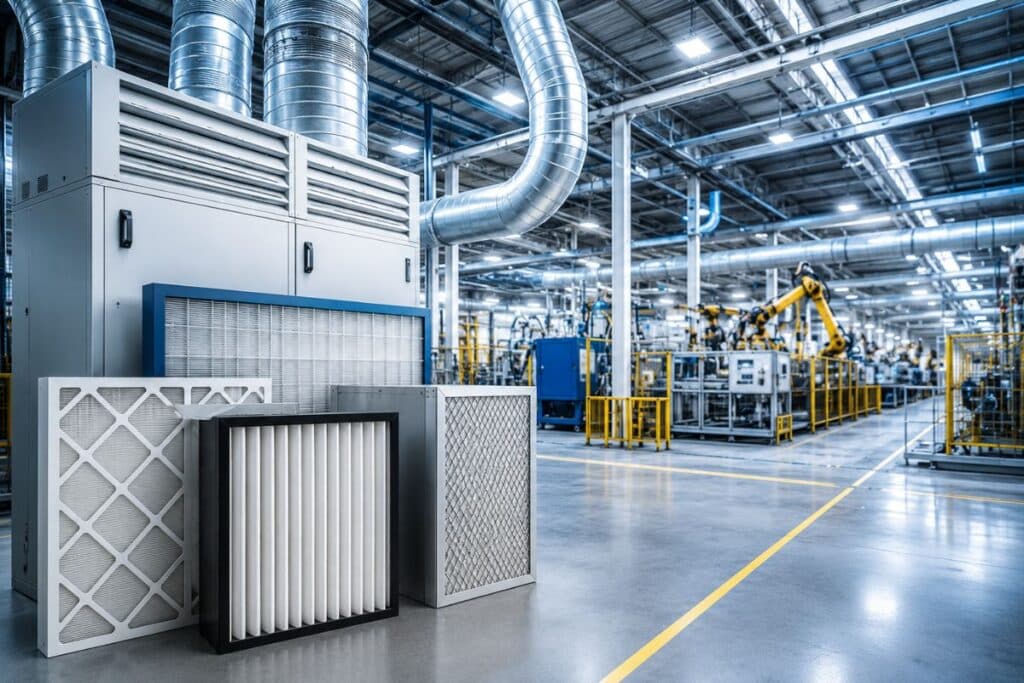
Mechanical filters (pleated, panel, and fiber media types) physically remove solid particulates. They are the workhorse of manufacturing. Dust, fumes, general airborne solids. MERV ratings are a measure of efficiency. In manufacturing, MERV 9-12 filters are suitable for general dust, while MERV 13+ filters are designed for finer particulates like metal dust and combustible powders.
Baghouse Dust Collectors: High-Volume Capacity
They are fitted with fabric filter bags that collect fine particulate matter from high volumes of air. Baghouse systems can achieve collection efficiencies as high as 99.9%, which is exceptional performance for heavy industrial applications. They are common in metalworking, woodworking, and mining, handling air flows ranging from a few thousand CFM to 50,000+ CFM. Fabric bags are disposable and economical in the long run.
Cartridge Filtration: Compact Efficiency
Cartridge filters provide the largest filtration surface area in a small footprint, making them ideal for applications such as welding fumes, powder coating, and pharmaceutical plants. Cartridges require 60% less floor space than baghouse systems and maintain comparable efficiency, an important benefit for facilities with limited space.
Electrostatic Precipitators (ESP): Energy-Efficient Collection
Electrostatic precipitators employ electrostatic forces for charging and collection of very fine particulates and smoke. They are well suited for power generation, cement making, and steel manufacturing with enormous air quantities and low pressure drop, but high efficiency (>99%). The advantage: fewer filter changes and lower operating costs.
Activated Carbon Filtration: Gas and Odor Control
In manufacturing processes that produce volatile organic compounds, chemical vapors, or odors (such as paint shops, solvent processes, or chemical processing), activated carbon filters trap gaseous pollutants that mechanical filters cannot. Many industrial air filter solutions combine mechanical and activated carbon stages for comprehensive contamination control.
HEPA and ULPA Filters: Ultra-Clean Environments
To make air extremely clean for pharmaceutical production, electronics assembly, and precision optics, you need HEPA filters that capture 99.97% of particles 0.3 microns and larger, or ULPA filters that capture 99.9995%. They’re more expensive, but they offer uncompromised air purity for contamination-sensitive operations.
Features Every Manufacturing Plant Should Look For
Some of the most valuable features include:
Multi-Stage Filtration
The use of coarse filters before fine filters extends the life of the equipment and increases overall filtration efficiency.
Smart Filter Monitoring
When filters need to be changed, pressure sensors and digital monitoring systems alert maintenance teams, cutting down on unnecessary downtime.
Energy-Efficient Fans
Variable Frequency Drives (VFDs) automatically adjust the airflow to match the demand, reducing electricity use.
Explosion Protection
If you have combustible dust, focus on facilities with explosion vents, suppression systems, spark detection, and isolation valves.
Anti-Static Filter Media
Anti-static filters must be used by manufacturers processing conductive materials like aluminum or carbon black to reduce the risk of ignition.
Easy Maintenance
Side-access filter housings, quick-change cartridges, and modular designs reduce maintenance time and improve worker safety.
The Air Filters Northwest Approach to Manufacturing Filtration
At Air Filters Northwest, we have developed a methodology that is comprehensive in the implementation of manufacturing air filtration systems that actually work:
Step 1: Contamination Assessment
We analyze your facility’s airborne contaminants, airflow needs, and production environment to determine the most effective filtration solution. This is not guesswork, but data-driven analysis to determine the appropriate filtration technology.
Step 2: System Design and Integration
Based on assessment findings, we design integrated solutions addressing:
- Source capture at point of generation (extraction arms, hoods, downdraft tables)
- Appropriate filtration technology (mechanical, cartridge, baghouse, carbon, or hybrid)
- Proper ductwork and airflow management
- Compliance with OSHA, EPA, NFPA standards relevant to your operation
Step 3: Professional Installation
Our NAFA-certified technicians make sure it is installed correctly with proper ductwork sizes, seals in the filter housing, and system commissioning.
Step 4: Ongoing Maintenance and Support
We offer preventive maintenance schedules, filter change protocols, performance monitoring, and emergency support.
Protecting Your Workforce, Equipment, and Compliance with Air Filters Northwest
Call Air Filters Northwest at (503) 968-3261 for a comprehensive contamination assessment. Our team will:
- Measure your current air quality and contamination profile
- Identify regulatory compliance gaps
- Design customized industrial air filter solutions for your specific processes
- Ensure proper installation and ongoing optimization
- Provide 24/7 support during equipment issues or regulatory inspections
We have the entire filtration system in our 12,500 square foot warehouse, from basic MERV filters to baghouse and HEPA solutions. NAFA-certified technicians know manufacturing environments in a way that generic HVAC contractors just don’t.
GREEN IS THE BOTTOM LINE® – and investing in the right manufacturing air filtration systems is an investment in worker safety, regulatory compliance, and operational excellence that pays dividends for years to come.