When many buildings rushed to upgrade to MERV 13 filters after COVID guidelines, the goal was cleaner air. The reality was different. HVAC systems made for MERV 8 had a hard time all of a sudden; airflow was reduced, and some units even froze. The problem was not knowing what those MERV values really meant or if the system could handle the adjustment.
After more than 30 years in air filtration, this is a conversation we’ve had countless times. Facility managers, homeowners, and building operators all want the air inside to be cleaner, but not many people know what MERV signifies on an air filter. If you choose too low, the air won’t be cleaned very well. If you go too high, you could break valuable equipment.
This guide explains what MERV is, why MERV 13 is so popular, what MERV-A truly means, and how to choose the correct filter to get cleaner air without putting too much strain on your HVAC system.
Quick Definition: What is a MERV Rating?
The term “Minimum Efficiency Reporting Value” (MERV) stands for “Minimum Efficiency Reporting Value.” It is a standardized test method (ASHRAE 52.2) that checks how well an air filter picks up particles in three different size ranges:
- 0.3–1.0 microns
- 1.0–3.0 microns
- 3.0–10.0 microns
The filter is better at catching tiny particles if it has a higher MERV rating.
Why Do People Talk About MERV 13 So Much?
People started to pay attention to MERV 13 filters since they catch a lot of small particles, such as many respiratory aerosols. Health groups suggested MERV 13 as a good way to improve indoor air quality in public and commercial buildings during and after the pandemic.
That being said, MERV 13 isn’t always the “best” option. The size of the HVAC system still determines what grade is safe and useful. This is also where MERV-A comes in handy: it shows how a filter works over time, not only on the first day.
The Science Behind MERV Ratings
To find out how well an air filter works, it is tested against particles in three different size ranges:
- E1 (0.3–1.0 microns): smoke, some bacteria, combustion particles
- E2 (1.0–3.0 microns): mold spores, Legionella
- E3 (3.0–10.0 microns): pollen, dust mites, textile fibers
A human hair is around 50 to 70 microns in diameter, which is much bigger than the particles that MERV ratings detect.
To test it, standard test dust with certain particle sizes is pulled through a test duct and onto the filter. The filter has the highest MERV score when it meets all three minimum requirements for efficiency against all three size ranges.
For example, to achieve a 13 MERV filter rating, the tested filter must capture:
- At least 50% of E1 particles (0.3-1.0 microns)
- At least 85% of E2 particles (1.0-3.0 microns)
- At least 90% of E3 particles (3.0-10.0 microns)
Complete MERV Rating Chart: What Each Level Captures
| MERV Rating | Particle Size Efficiency | Typical Applications | What It Captures |
| MERV 1-4 | 3.0-10.0 microns: <20% | Residential window units, basic protection | Lint, carpet fibers, and large dust |
| MERV 5-7 | 3.0-10.0 microns: 20-50% | Standard residential | Mold spores, pet dander, dust mites |
| MERV 8 | 1.0-3.0 microns: 20%
3.0-10.0 microns: 70% |
Better residential, light commercial | Everything above + pollen, fine dust |
| MERV 9-10 | 1.0-3.0 microns: 35-50%
3.0-10.0 microns: 75-80% |
Superior residential, commercial | Legionella, humidifier dust, lead dust |
| MERV 11-12 | 0.3-1.0 microns: 20-35%
1.0-3.0 microns: 65-80% 3.0-10.0 microns: 85-90% |
Enhanced commercial, hospitals | Most bacteria, droplet nuclei, and coal dust |
| MERV 13-16 | 0.3-1.0 microns: 50-95%
1.0-3.0 microns: 85-95% 3.0-10.0 microns: 90-95% |
Hospital surgical, general surgery | Bacteria, tobacco smoke, sneeze particles, and virus carriers |
MERV vs MERV-A: What’s The Difference?
Some filters use an electric charge to make them work better at first. This can make a filter’s MERV score go up during testing, but that charge wears off as the filter gets dusty, which lowers its performance in the real world.
MERV-A testing gets rid of the electrostatic effect, which shows how the filter works during its whole service life. If you want long-term protection, MERV-A values are better than just MERV.
Don’t Assume Higher is Always Better: HVAC Compatibility Matters
Higher MERV filters create more airflow resistance. If your system isn’t designed for it, you may see:
- Reduced airflow
- Higher energy bills
- Coil freezing or blower strain
To safely handle MERV 13+, older systems may need thicker filters (4″ or 6″) or fan upgrades. Before updating, always check the restrictions on static pressure.
Practical Buying Tips (What to Check)
- Ask for MERV-A if available — it’s the “actual” sustained efficiency.
- Match the thickness of the filter (1″, 2″, or 4″) to the size of your HVAC slot. Thicker filters have a higher surface area and a smaller pressure drop for a given MERV.
- Look for ASHRAE 52.2 test data or certified MERV numbers in the manufacturer’s specifications.
- If your system can’t handle MERV 13 in-duct, use a MERV 8–11 in-duct filter together with room HEPA purifiers as needed.
- Stick to a plan; high-MERV filters can get clogged more quickly. Check them once a month at first.
Real-World Benefits You Can Measure
- Moving from a low-MERV filter to a MERV 11–13 filter makes a big difference for many homes when it comes to allergies.
- Workplace health: Better IAQ is linked to fewer sick-building complaints and measurable cognitive gains in tests (cleaner air helps individuals think more clearly).
- Protect equipment: In factories, better filters save fans and coils from getting dirty, which lowers maintenance expenses. (But keep in mind that you have to use filters that strike a balance between efficiency and system capacity.)
Make the Right MERV Choice with Air Filters Northwest
Air Filters Northwest can help you find the proper air filter MERV rating for your building and budget so that you may breathe cleaner air without putting too much strain on your HVAC system. For a professional opinion and clear advice based on more than 30 years of expertise, call (503) 968-3261. GREEN IS THE BOTTOM LINE®—and picking the correct MERV filter is an investment that keeps air quality, equipment, and long-term performance safe.
FAQs
Q: What does MERV mean on an air filter?
A: It’s the Minimum Efficiency Reporting Value — a standardized rating that shows how well a filter captures particles across 0.3–10 µm size ranges.
Q: Is a MERV 13 filter worth it?
A: For many commercial spaces and allergy-prone homes, MERV 13 is a strong upgrade. But always confirm your HVAC can handle the pressure drop, or consider a thicker filter or supplemental room purifiers.
Q: What is MERV-A, and why choose it?
A: MERV-A tests the filter without electrostatic charge — it shows the more realistic, sustained efficiency over the filter’s life. Choose MERV-A when you want long-term performance.
Q: How often should I change a high-MERV filter?
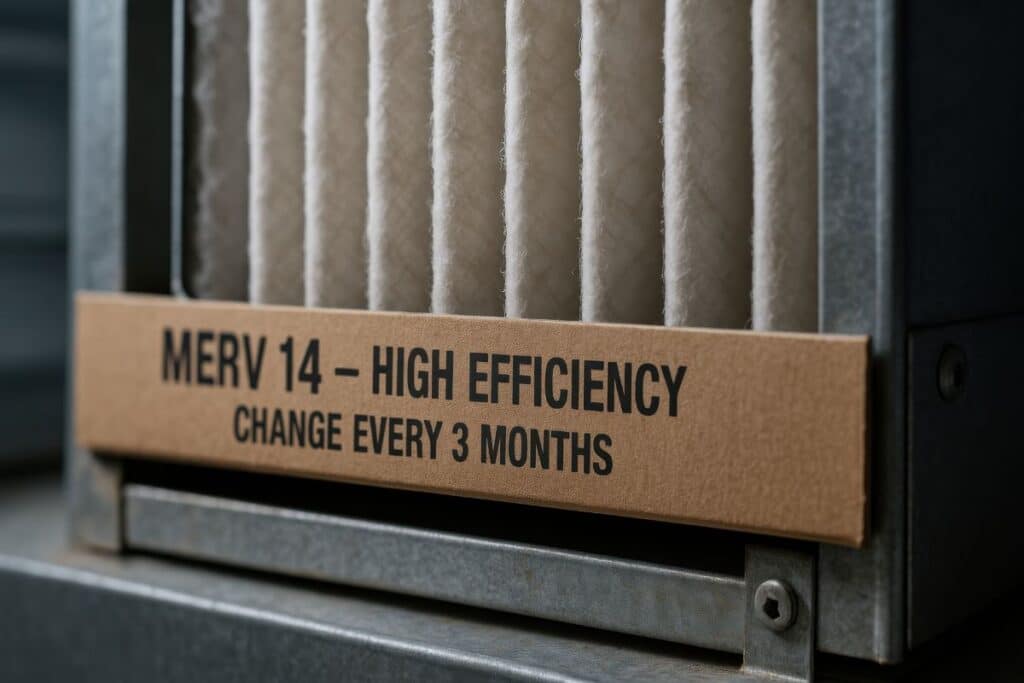
A: Check monthly for the first two months; many high-MERV pleated filters need replacement every 60–90 days, but heavy dust, pets, or wildfire smoke shorten that. Visual inspection is the best guide.
Q: What's the difference between MERV 8, 11, and 13 filters?
A: MERV 8 catches roughly 70% of particles that are 3 to 10 microns wide (such as pollen and dust mites) and 20% of particles that are 1 to 3 microns wide. MERV 11 catches 85% of 3–10 micron particles, 65% of 1–3 micron particles, and 20% of 0.3–1 micron particles, which is better for allergies. MERV 13 filters out 90% of 3–10 micron particles, 85% of 1–3 micron particles, and 50% of 0.3–1 micron particles. It is hospital-grade filtration that catches droplets that carry bacteria and viruses.