We’ve been in the air filtration business for 30 years, and we’ve seen the same problem happen again and again: using improper filters in places that need more protection. One location that was recently checked was using ordinary MERV 13 filters when HEPA filtration was definitely necessary. That tiny variation in efficiency—about 85% vs. 99.97% particle capture—was making the air quality worse and costing money that didn’t need to be spent.
This isn’t a common mistake. Many hospitals, data centers, schools, factories, and commercial facilities have trouble with indoor air that may be fixed with efficient high-efficiency particulate air filtration. Most of the time, the difference is that people don’t know what HEPA filters do and why that extra level of particle removal is important.
HEPA filters are an easy way to improve things right away. They make the air cleaner, the people inside healthier, and the facility’s performance much more stable. This blog explains the real benefits of HEPA filters in simple terms so you can decide if your building requires this degree of protection and how to install it correctly.
Top HEPA Filter Benefits (Quick Summary)
- Cleaner indoor air — removes dust, allergens, and many airborne pathogens.
- Health gains — fewer allergy and asthma triggers; fewer sick-building symptoms.
- Reduced transmission risk — useful layer in infection control strategies in clinics and schools.
- Lower HVAC maintenance costs — protects downstream equipment and keeps coils cleaner.
- Better occupant comfort & productivity — people feel and perform better in cleaner air.
What Makes HEPA Filters Different And Why It Matters
HEPA filters are distinct from other types of filters, and to understand why, you need to grasp what we’re really fighting against.
The diameter of a single hair is between 50 and 70 microns. Most regular filters can trap particles as small as 10 microns. But what about the really bad stuff? We’re talking about particles that are between 0.3 and 0.9 microns in size. They are small enough to get past the hairs in your nose and become stuck deep in your lungs, but too big to be breathed out.
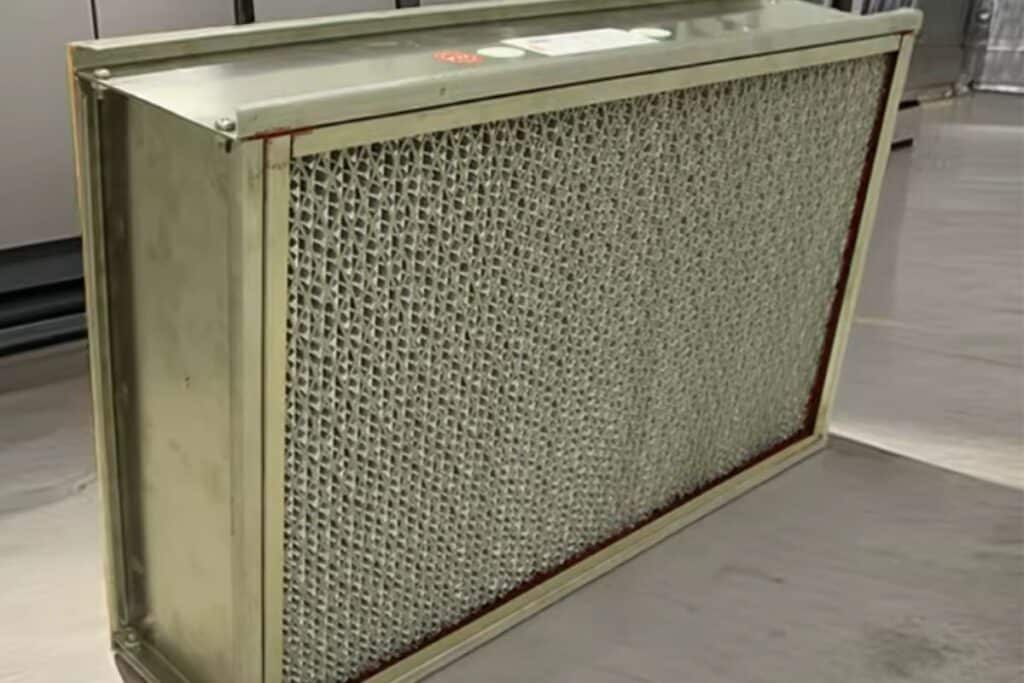
This is where high-efficiency particulate air technology really shines. True HEPA filters catch 99.97% of particles that are 0.3 microns in size, which is the size of particles that can go through the most easily. They do this by using a complex web of glass fibers that are 75 times thinner than a single human hair. The strands are braided into many layers and folded into a concertina shape to make the most of the surface area.
The Real-World Benefits of HEPA Filters You Can Actually Measure
Better respiratory health: We put HEPA filters in a university dormitory that had a lot of mold problems and kept track of how many sick days the inhabitants took. Absences due to respiratory problems fell by 42% during the course of six months. Students with asthma said they had 58% fewer days with symptoms. This wasn’t simply hearsay; the university health center kept track of the improvement.
Stopping the Spread of Viruses: During the COVID-19 pandemic, places that had ultra-low particulate air filtration systems set up correctly had far lower transmission rates. Research from Harvard found that greater air quality made people do 26% better on cognitive tests and 30% less likely to have “sick building syndrome” symptoms.
Productivity Gains That Impact Your Bottom Line: The same Harvard study found that improving air quality by HEPA filtration is worth almost $6,500 per employee each year in productivity increases. This is a number that every business owner should pay attention to. The World Green Building Council says that cleaner air makes workers 8 to 11 percent more productive.
Where HEPA Really Makes a Difference
Not every situation needs HEPA, but in these cases it’s a must:
- Healthcare & labs: operating rooms, isolation areas, and clean labs rely on HEPA/ULPA levels.
- Clean manufacturing: semiconductors, pharmaceuticals, biotech — processes that reject contamination.
- Schools & offices: portable HEPA units + improved ventilation reduce background aerosol loads.
- Homeowners with allergies or smoke concerns: portable HEPA purifiers can dramatically reduce indoor irritants.
- Data Centers: Data centers are increasingly recognizing that airborne particulates can cause equipment failures, shortened component life, and system crashes.
HEPA filters are the best way to safeguard delicate processes, vulnerable people, or to lower the amount of airborne pollutants during events like flu season or wildfire smoke.
HEPA Vs. Other Filter Types
- Standard HVAC filters (MERV rated) — good for general dust and larger particles; lower pressure drop but not HEPA-level capture.
- Electrostatic filters — can be effective, but performance varies, and some generate ozone or require cleaning.
- HEPA filters — best-in-class for particle capture; higher pressure drop requires appropriate system design or dedicated purifiers.
- ULPA / Ultra-Low Particulate Air — even higher efficiency than HEPA for ultra-critical cleanroom uses.
Always think about how well the filters work in relation to the HVAC system’s capacity (fans and static pressure) when you think about upgrading. Adding portable HEPA air cleaners to a space is often the quickest and safest option to attain HEPA-level performance without having to change the core system.
Market Growth Signals Widespread Recognition
Companies are spending money on improving IAQ, which is good for the HEPA industry. The global market for HEPA filters was worth $2.48 billion in 2018 and is expected to grow at a rate of 7% per year to reach $6.87 billion by 2032. The U.S. HVAC industrial filtration market is rising at a rate of 4.2% per year, while the HEPA sectors are growing even faster, at 4.8% per year.
This is recognition that the benefits of HEPA filter technology deliver measurable, quantifiable value across virtually every industry.
How to Pick and Use HEPA Filters the Right Way
- Decide the goal — process protection, infection risk reduction, allergy relief, or smoke control?
- Choose the form factor — in-duct HEPA (for HVAC retrofits), terminal units, or portable HEPA purifiers.
- Check true HEPA spec — insist on the 99.97% @ 0.3 µm rating (or higher). Beware of vague marketing terms.
- Match capacity to room size — for portable units, use Clean Air Delivery Rate (CADR) or target 4–6 air changes/hour (or more for high risk).
- Account for pressure drop — if installing in-duct HEPA, verify the fan system can handle the extra resistance.
- Maintain regularly — HEPA filters work best when changed at recommended intervals; clogging reduces airflow and effectiveness.
Take Action: Improve Your Air Quality Today with Air Filters Northwest
If you’re worried about the air quality in your building or just want cleaner, healthier air, upgrading to real high-efficiency particle air technology is a wise long-term investment that will show results.
Call Air Filters Northwest at (503) 968-3261 for a clear, personalized plan. Our staff will look over your current filtration system, figure out what’s lacking, and suggest ways to make the air cleaner and the system work better.
FAQs
Q: What makes a HEPA filter different from a regular HVAC filter?
A: A HEPA filter meets a minimum performance test — capturing 99.97% of 0.3 µm particles — whereas regular HVAC filters are rated by MERV and typically don’t reach HEPA-level capture.
Q: Will a HEPA filter stop viruses?
A: HEPA captures many aerosol particles that can carry viruses; it’s a strong layer of protection, but it works best combined with ventilation, masks, and other controls.
Q: Can my current HVAC system handle HEPA filters?
A: Maybe — older systems often need fan upgrades to handle the higher pressure drop. Portable HEPA units are a practical alternative.
Q: What is ULPA vs HEPA?
A: ULPA (Ultra-Low Particulate Air) offers even higher filtration efficiency than HEPA and is used in extreme cleanroom and lab contexts.